
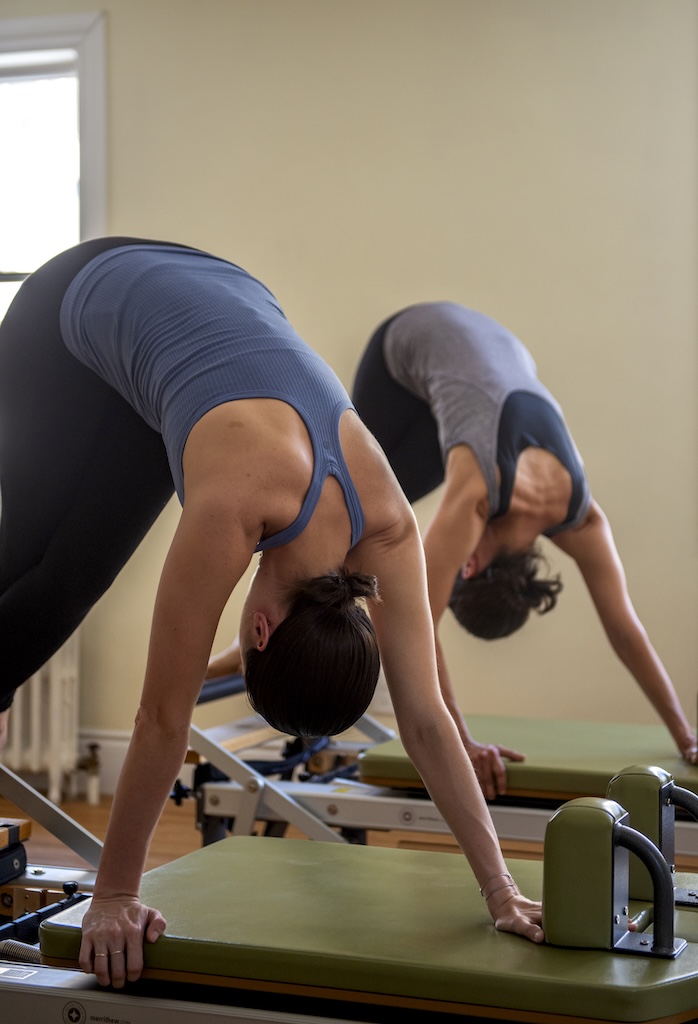
For instructors who are new to teaching Pilates group classes, one of the biggest obstacles is finding the words to teach each Pilates exercise effectively.
As studio directors and mentors, we can help them define their teaching style so that their individual approach is showcased, while keeping the class energy inspirational and motivational, with that “yes you can!” vibe.
As I continue to mentor Pilates instructors to explore and strengthen their teaching skills, I’ve realized the power of Connection, Clarity, Consistency and Community.
These 4 C’s are not only instrumental for finding the right words for effective cues, but they also provide structure to shaping cues that make sense and resonate with every group class participant.
When the right words are found, it can make a world of difference in an instructor’s confidence to teach a Pilates group class regardless of their experience or the group class size.
Connection
Cueing simple or familiar exercises in Pilates is sometimes the hardest – I mean, how many different ways can we cue or correct the Reformer Footwork when a client has already done it a thousand times?
But this is precisely where great Pilates instructors begin to go deeper into their cues, images and corrections; not only to keep their clients engaged but to keep themselves focused on the exercise they’re teaching and how different approaches can change the clients’ movement experience.
How?
By anchoring their cueing into words that connect clients into their breath, pelvis position, spinal alignment and shoulder girdle positioning.
Or by emphasizing connections into the more subtle aspects of an exercise such as the control of the equipment, the quality of their movement and where in their body they should be feeling the work.
Orienting your Pilates teaching cues and corrections back to your clients’ body, position, movement and control of the Pilates equipment, will not only connect their focus to their movement, it will improve their overall awareness, mind-body connection and attention.
Clarity
Being clear is key. Because images are great, but if they’re too abstract or unknown, their impact is lost.
Concepts that often resonate best with clients tend to be universal: the sensation of pressing our hands through water to emphasize the quality of resistance, the shape of a race track to emphasize the continuity of the Reformer carriages movement, the visualization of an umbrella opening (or closing) to encourage expansive, postero-lateral ribcage and diaphragm breathing.
Whatever images you share, make sure you understand the value they’ll bring to the exercise you’re teaching; how does it apply and why can it work?
And I still maintain that the very best way to do this is through your own focused, regular and prioritized Pilates practice and by participating in a class taught by an experienced Pilates instructor whose teaching approach resonates with you.
Consistency
Once you’ve found the cues and connections to help your clients engage and understand the Pilates exercises you’re teaching, think about this;
Keeping things consistent doesn’t mean you can’t change the class program.
It means keeping a steady and familiar pace.
So instead of changing the exercises every week, focus on changing how you’re teaching the exercise and what you’re emphasizing in that particular class by incorporating appropriate variations and modifications.
Consistency is an essential learning tool for clients. But it’s also instrumental for instructors to develop their verbal teaching skills and learn how to progress Pilates programming by layering new exercises onto those that have already been taught.
End result of consistent cueing in each Pilates group class?
A more rewarding client experience and teaching experience.
Community
Some of the best Pilates instructors I know successfully lead group Pilates Reformer classes with cues that are helpful not only to the individual who specifically needs them, but for every participant in the class.
If you notice that someone is losing connection in their legs while lying prone on the Reformer Long Box, bending their elbows while doing The Hundred or losing pelvic stability during Feet in Straps, find the cues that will support them while also reminding the entire class to ensure they’re also engaged, active and stabilizing.
Standing alongside the client who is prompting this awareness cue while speaking to the entire group, is creating a group class experience, with all of its great progressions and connections, community based rather than individualized – which is what group classes are all about.
As a Pilates group class instructor, I’ve found that cues that benefit one client will always benefit everyone else.
And as a participant in my favourite Pilates group classes, I’ve been more connected to the class energy and my instructors teaching when they’re focused on moving, teaching and correcting all of us as a collective community.
So there you have it – The 4 C’s of Connection, Clarity, Consistency and Community.
While every Pilates instructor has their own teaching style and approach, finding the words for clear and consistent cues that create connections and inclusivity for every group class participant is part of evolving into a strong, confident and sought after Pilates teacher.
Enjoy the process and have fun!!