
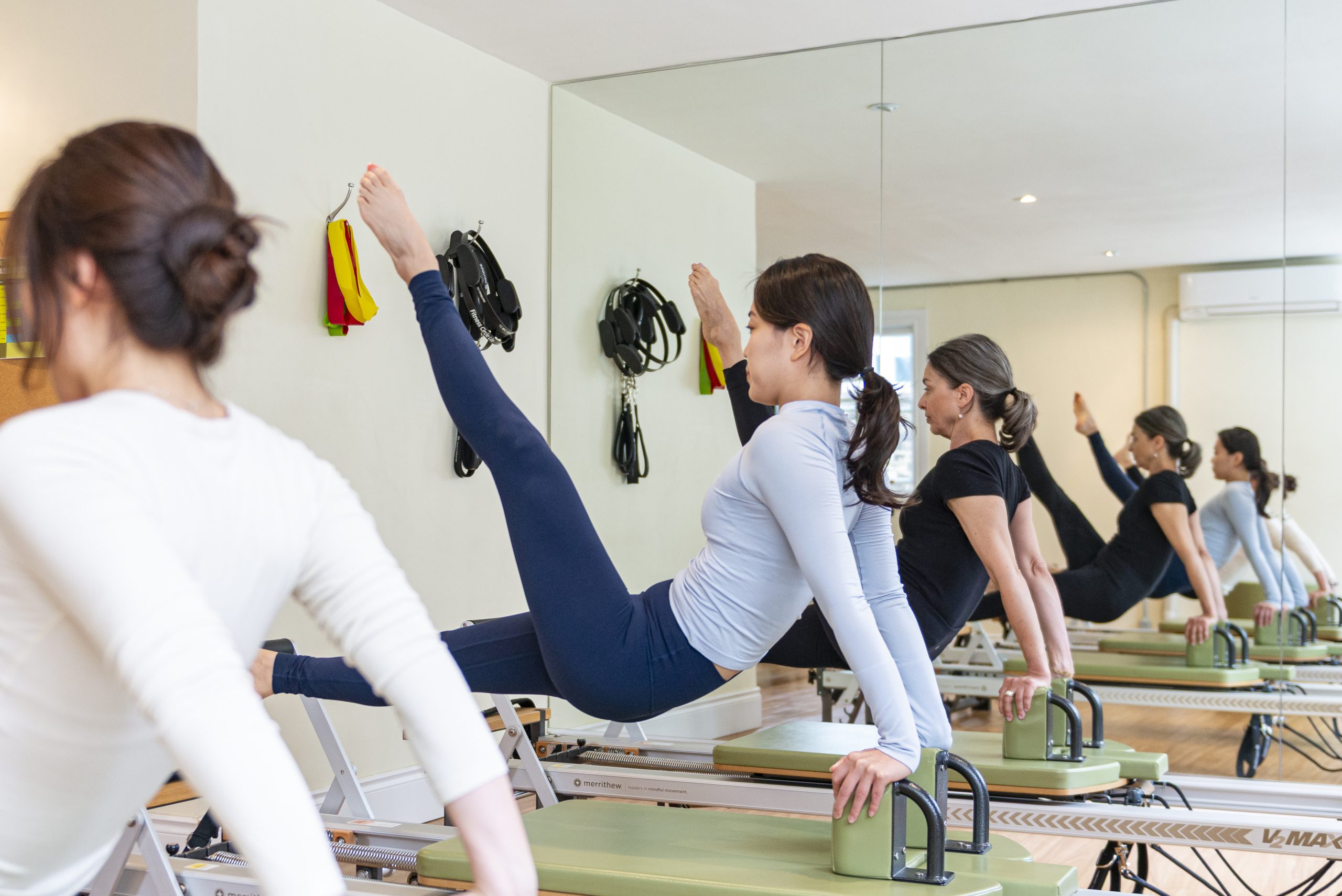
Studio³ has operated out of 2 spaces since opening its doors in 2008. Our first studio held 2 Reformers, 1 Cadillac, a Ladder Barrel and a Stability Chair.
Our Pilates classes were Mat based only and we prioritized Pilates privates and semi-privates.
When we moved to our current location in 2013 we had 1 floor with 4 Reformers less than 8 inches away from one another, a Cadillac and 1 more Chair.
Our instructors taught the occasional group class. But our reputation for Pilates privates and semi-privates in Toronto had grown to be the lion’s share of the schedule.
When we gained access to the third floor in 2010, our vision was to offer small group Pilates classes.
And the size of our classes was determined by the space we have.
So, with more than 12 inches between each Reformer, our group classes are at capacity with 4 people.
As the owner, I often day dream about what I would do if our small, mid-town building suddenly sprouted a fourth floor that we had full access to; would we expand to six person classes? To eight? Or maybe even ten?
Having taught larger Pilates classes in different studios at different stages in my 30 years Pilates career, my answer is always no.
To be clear, if that additional space was ever somehow realized, I would optimize it with more group options.
But 30 years of teaching Pilates has taught me that those options lie in different, more creative alternatives than just larger group Pilates classes.
As director of a team of 10 + instructors, I’ve learned that the best Pilates group classes are small enough for individualized guidance yet large enough to stay affordable and accessible.
And don’t get me wrong; the bottom line always matters and larger classes, when consistently full, are revenue drivers.
But at Studio³ we’ve learned that smaller classes prioritize a better experience for instructors and clients; and ultimately, if done properly, they can be profitable for both instructors and the studio.
We’ve also learned that teaching smaller Pilates classes expands our instructors’ Pilates teaching expertise vertically rather than laterally; and by default of numbers, they truly get to know each client and their goals.
This makes programming adaptable and accessible for every participant and builds consistency throughout the studio class schedule.
Which brings us to one of the most important lessons we’ve learned as a small but might Pilates studio offering small group classes:
Consistency builds trust and trust builds loyalty.
If you’re a Pilates enthusiast looking for a new Pilates experience or studio owner or Pilates instructor looking to offer different client offerings and teaching options, here are three reasons why smaller Pilates classes can be more beneficial:
- Deeper Connections.
Smaller Pilates classes mean more attention on the individuals in the room.
So even if it’s a mixed level Pilates group class, a fully certified instructor who has experience working with different bodies will know how to regress and progress each exercise.
A smaller group allows instructors to teach comprehensively so clients will experience the value of quality Pilates.
And it provides participants with the opportunity to learn and retain foundational principles of a Pilates workout. This will improve their form, strength and mobility in each subsequent class.
- Proper Progressions.
A while ago a friend told me that he took advantage of a promotion being offered by a new Reformer studio near his house.
He mentioned that while he didn’t retain too much of the daily workout, he was proud that he didn’t fall off the Reformer, because that seemed to be the challenge presented by each instructor.
I’m not exactly sure when not falling off the equipment became a goal for Pilates classes.
But beyond setting a low bar of achievement, being concerned about falling and injuring yourself isn’t exactly an ideal mental or physiological state that anyone should be in during any type of fitness class. Ever.
In a smaller Pilates group class, participants are properly supervised doing challenging Pilates exercises that demand greater balance, control and proprioception.
Rather than avoiding these exercises, or worse, attempting to do them without a proper connection or understanding of how to do them, smaller Pilates classes can build them safely into the group class workout.
This makes doing them rewarding and, if properly taught, achievable.
And it’s also what makes Pilates, well, Pilates.
- Meaningful Experiences.
Any trainer offering private sessions knows the hour is more than just a workout; it’s a weekly space to connect, engage and offer up their expertise and knowledge to clients seeking to improve their movement potential.
While it’s generally accepted that a group class means less time on each individual, a smaller Pilates group class ensures that these important attributes that build retention and client loyalty are integrated.
Whether it’s a drop in class or group series, better client experiences are cultivated when instructors have the time to learn about their clients and why they’re doing Pilates.
And to build client goals into their Pilates group programming is almost always more consistent, genuine and manageable when the group they’re teaching is smaller.
Deeper connections, proper progressions and meaningful experiences are probably not the reasons why clients are initially doing Pilates – and they don’t have to be.
But if your goal is a long term, lifestyle enhancing, quality fitness routine that focuses on improving physical awareness, strength and movement confidence in a fun, community based environment, then smaller group Pilates classes are almost always the best way to achieve it.